

According to new seedcane regulations, by 2028, only certified or approved seed sources may be used for planting commercial sugarcane fields. With this deadline fast approaching, it is strongly recommended that you establish your own certified and approved nurseries. Doing so allows greater control over the varieties you wish to plant, and the timing of planting.
Relying entirely on third-party suppliers for seedcane poses several risks: growers will have limited influence over variety selection and planting schedules, and there is always the potential for delays or even loss of seedcane if the third party prioritises other customers.
One of the central components of meeting the 2028 deadline is sourcing seedcane for establishing certified nurseries. There are currently three options:
- hot water treated (HWT) whole stick seedcane (50°C for 2 hrs),
- HWT single-budded sett transplants (50°C /40 min), and
- NovaCane® plantlets.
This plays an important role in ensuring that only good quality, disease-free material is planted.
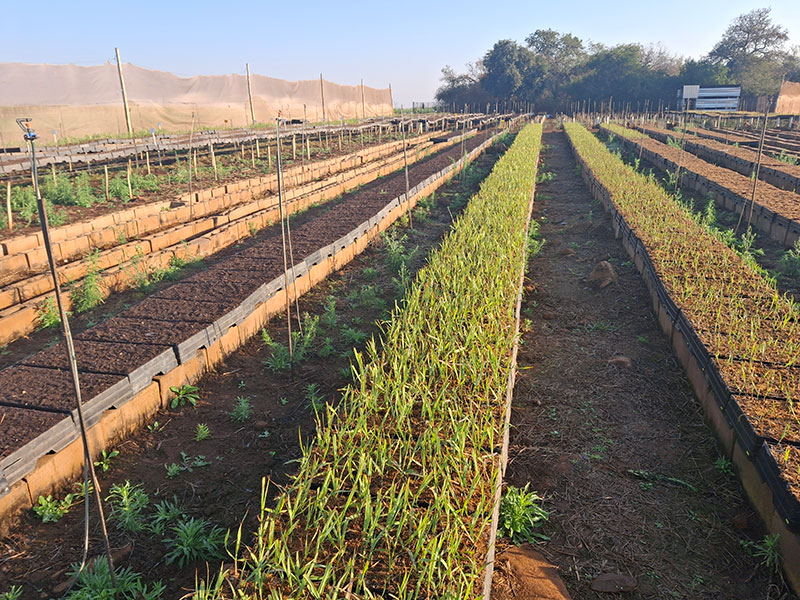
To ensure the Komati area meets the 2028 deadline, the Komati Speedling Nursery was established in 2023 by the Komati Growers Association, with support from SA Canegrowers. Since June 2025, SASRI has been responsible for the daily management of the nursery’s operations.
At the Komati Speedling Nursery, HWT single-budded sett transplants are propagated for planting into certified nurseries. The nursery is equipped with a continuous flow hot water treatment tank that can also accommodate whole stick seedcane.
Making transplants from single-budded setts
With single-budded setts, each cane stalk is cut into nodal sections consisting of one bud with root primordia from which a new plant can grow. Once single-budded setts have undergone HWT, they can be used to propagate new sugarcane plants. This propagation method involves growing the treated setts in a controlled nursery environment to ensure healthy development.
Cane stalks are cut into single-budded setts using a double-bladed saw. The setts are then placed in vegetable bags and treated in hot water at 52°C for 40 minutes. After the heat treatment, the setts are dipped in a fungicide solution for 15 minutes. This step helps cool the setts and protects them against sett rots and other fungal pathogens.
Next, the treated setts are placed in a germination room maintained at 32°C with humidity levels above 70%. After two days, the setts are inspected, and any that are defective or damaged are removed. The remaining setts are then planted into 98-cell trays filled with a growing medium made from well-composted manure and sand. A NPK fertiliser is added to the medium to support early growth. Currently a standard 2:3:2 fertiliser is used but this will be replaced with a slow release NPK fertiliser going forward.
The trays are returned to the germination room until the buds start to swell, which typically takes between 4 and 7 days. Once most of the setts have germinated, they are checked again, and only those that have successfully germinated are transferred to the nursery. Each variety is well marked on the bench. Only one variety is processed at a time to decrease the risk of varietal mixing. In the nursery, the young plants continue to grow under daily irrigation. Nitrogen is applied as needed, and pest control measures are taken to ensure healthy development.
Based on experience at the Komati Speedling Nursery, the following differences between single-budded setts and whole stick seedane are apparent:
| Single Budded Setts | HW Treated whole stick | |
| Quantity of seedcane required | Approximately 2 tons/ha | Approximately 18 tons/ha |
| Logistics | Easier handling and transport | Higher transport costs (location dependent) |
| Cost of HWT, transport and seed | Approximately 25% less than whole stick | HWT, transport and seed can be 25% more than HWT-single budded setts |
| Bud damage risk | Slightly higher risk during handling | Lower risk due to reduced handling |
Example of a phased replanting strategy (25 ha over 3 years)
- Year 1: Plant 1 hectare of certified speedlings.
- Year 2: Use the certified area to plant 5 hectares of approved seedcane.
- Year 3: Use the approved nursery to plant 25 hectares of commercial seedcane.
(Using the following parameters: Seedcane yield: 80 t/ha; Planting rate: 16 t/ha)
Key criteria for certified and approved nurseries
- Certified Nurseries:
- Only the plant and first ratoon crops may be used to establish approved nurseries.
- Fields must lie fallow for at least one year before planting a certified nursery.
- At least six months of this fallow period must be free of any volunteer cane.
- This is a good opportunity to plant a low growing cover crop or a cash crop.
- Approved Nurseries:
- Only the plant and first ratoon crops may be used for further propagation.
- Fields must lie fallow for nine months, with six months free of volunteers.
- Inspection Requirements:
- Ensure that your local Pest & Disease (P&D) team is aware of all nurseries on your farm and that both your fallow fields and your certified/approved nurseries are inspected according to the requirements outlined in SASRI’s Seedcane Production Manual for more information.