
RD&E Workshops
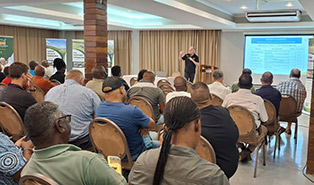 During February-March 2026, six regional Research, Development and Extension (RD&E) workshops were convened. At these workshops, feedback reports on RD&E topics received from the regions during 2024/2025 were given. This provided growers and other participants with insights into how SASRI addressed RD&E topics and how some of those topics led to new projects starting in 2026. The rest of each workshop focused on the collation of new RD&E topics that require SASRI’s attention. Internal discussion sessions are currently taking place at SASRI to develop an action plan for each new RD&E topic received.
Plant breeding
New site for plant breeding: Growers expressed the need for varieties suitable for cultivation on sandy soils with longer (18–24 month) cycles. A new site for the sandy soil breeding programme has been identified in the Midlands. Planting will commence shortly, and this will allow the selection of new breeding populations.
Mutagenic breeding: This novel approach to chemically induce beneficial mutations has resulted in herbicide tolerance, e.g. N12 Zapyr. Current work is repeating this protocol with N58. Other traits being evaluated in the laboratory or in pot-based assays include salt, aluminium and drought tolerance. Field trials to check for stable agronomic characteristics will follow.
Developing approaches for SSG engagement
 To better understand the productivity challenges faced by small-scale growers (SSGs), SASRI conducted a project across 11 regions involving 585 participating SSGs. The project focused on developing approaches and resources to improve support for SSGs, in collaboration with SASRI extension specialists, Department of Agriculture and Rural Development (DARD) agricultural advisors and SSGs. These approaches and resources can now be used as a platform to enable learning amongst SSG communities as to how the economic potential of their crops may be realised through the implementation of SASRI best management practices. Key challenges among SSGs included weed management, matching varieties to soil types, contractor performance, and access to and timely ordering of seedcane.
Lighting the way to better eldana monitoring
 Insect trapping is essential for monitoring pest populations in genetically modified (GM) Bt crop systems and sterile insect technique (SIT) programmes, enabling early detection of resistance and assessment of sterile-to-wild insect ratios. Current research at SASRI aims to develop an effective eldana moth trap by combining LED light, photoluminescent paint, and attractant lures for future use in these programmes. Preliminary laboratory results showed that combining blue-luminous traps with phenolic volatiles significantly improves moth catch, suggesting a synergistic effect between visual and chemical cues. These findings highlight the potential of integrating these cues in trap design for eldana monitoring and management in sugarcane systems.