

While there is no substitute for scientifically designed and conducted trials, simple on-farm observational trials may assist the farmer to compare products or product rates. If it is necessary to observe how a product performs under certain conditions, then observation trials could provide useful information.
Often, farmers will buy enough product for a few hectares, treat one field and leave another untreated, and then compare the responses, sometimes even comparing responses of a particular field this year to that achieved last year. Unfortunately, such an approach will not help a grower to draw any valid conclusions, and is a waste of resources.
Basic guidelines for the establishment of observation trials
- Choose a place in a field where the soil and cane growth is uniform.
- Keep it simple; compare a maximum of three treatments, i.e. your standard treatment plus two variations.
- Either rectangular ‘plots’ or long ‘strips’ can be used for the trial layout.
- A control, or standard treatment, is vital in order to measure any improvements over standard practice. This will provide your ‘baseline’ with which to compare the other treatments.
- Repeat treatments at least 3 times – i.e. if there are 2 treatments, repeat them each 3 times in different plots or strips: 2 x 3 = 6 plots or strips in total (Figure 1). This allows you to obtain an average for each treatment, in case there is variation in the field.
- Start the trial at least 5 m inside the field to overcome any end effects in the cane growth.
- Each plot or strip must be at least five rows wide and a minimum of 10 m long (Figure 1).
- Distinguish your treated and untreated rows with some visible marking (Figure 2). A sketch or map of the trial will also help.
- Apply all the treatments on the same day.
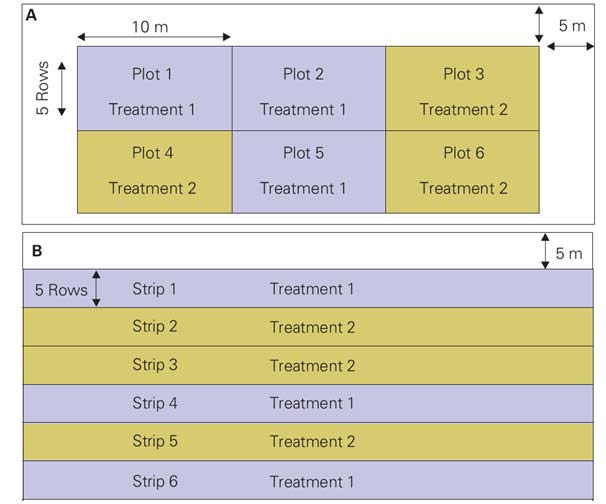 Figure 1. Field layout of a simple on-farm trial. Note: each treatment should be repeated 3 times at random throughout the field. Trials can be prepared in plots (A) or strips (B). If using a strip layout, each strip should be at least 5 rows wide and can continue for the length of the field.

Figure 2. Marking plots with plastic pegs in an on-farm trial.