

Buhle Khomo (Extension Specialist- Lower South Coast)
Some areas of the industry have experienced very dry weather conditions during the current season. The Lower South Coast regions have recorded only two months exceeding the long-term mean (LTM) rainfall over the past 10 months (August 2025 to May 2026), with six of these months receiving less than 50% of the LTM rainfall. Sugarcane grown on hilltops, particularly on shallow soils with limited rooting depth, has shown severe symptoms of drought stress. In many cases, most leaves are dry and stalk growth is extremely limited.
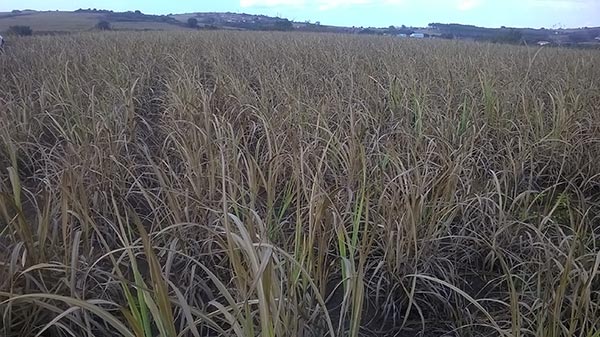
Drought stressed cane.
Harvesting
Growers are advised to harvest all drought-stressed cane as soon as possible, provided it is millable. It is therefore important to determine whether cane is millable or unmillable before making management decisions.
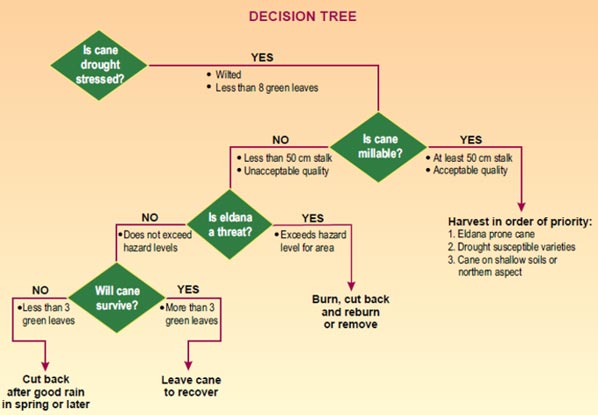
- Millable cane is cane with at least 50 cm of stalk growth and acceptable quality.
- Unmillable cane is cane with less than 50 cm of stalk growth. This cane should be cut back to encourage better regrowth when rainfall improves.
- Dry cane of poor quality is unlikely to be economical to harvest and should be treated as unmillable.
Where cane is extremely dry and has three or fewer green leaves, it is unlikely to survive even when rainfall returns and should therefore not be carried over. Where a decision has been made to cut back cane, this should be done by hand to protect the already weakened root system from machinery damage. Note that drought-stressed cane is prone to sour rot infection, which will impact cane quality.
The decision tree below can be used as a guide to assist with decision-making in drought-affected fields.
Crop Nutrition
Topsoil and subsoil acidity can cause stunted root development, reducing the crop’s ability to take up water and nutrients. Managing soil acidity therefore provides several benefits, including improved nutrient availability and enhanced root health. This is particularly important during dry seasons when access to water and nutrients is limited.
Where the crop has not achieved 50% of its estimated yield potential at harvest, nitrogen (N) fertiliser applications, for the ratooning crop, at top-dressing can be reduced by up to 20 kg N/ha, as some nitrogen reserves are likely to remain in the soil. However, phosphorus (P) and potassium (K) fertilisers should still be applied in accordance with Fertiliser Advisory Service (FAS) recommendations to ensure an adequate nutrient supply for crop recovery and future growth.
Eldana on drought-stressed cane
Stressed cane loses its natural defences, making it an easy target for eldana. Significant yield and quality losses have been observed in the past due to eldana infestation on drought stressed cane. It is therefore recommended that all stressed cane be surveyed for eldana, and that cane with levels above local carry-over limits not be carried over to the following season. Ideally, all stressed cane should be harvested in the current season to avoid infestation during off-season, as stressed cane is more susceptible to eldana. Use of an IRAC-compliant insecticide spray programme should be considered where cane is scheduled for carry-over.
For more information on managing drought-stressed cane, please refer to Information Sheet 2.3 Management of Cane Affected by Drought.