

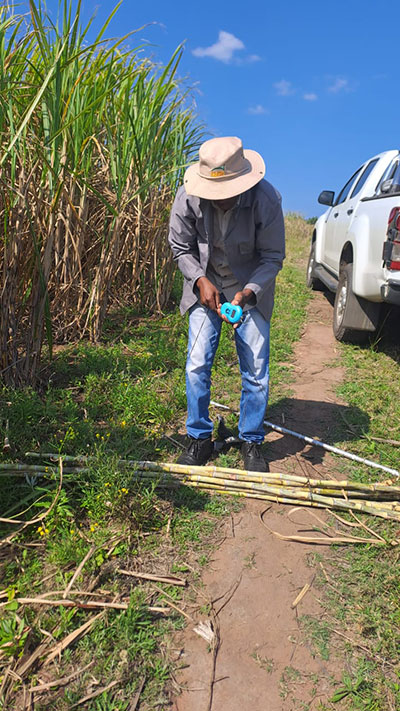
 Yield estimation is an important part of planning each harvesting season. Growers begin this work in March by listing all fields, their areas, and their ages as at 1 April. Even fields not intended for harvest must be included, as this helps industry committees monitor young cane and track pests and diseases more accurately.
The estimate focuses on the expected yield at the time of harvest. Several simple methods are used across the industry:
- Sampling and weighing is often the starting point when limited field history is available. By counting stalks per metre, calculating the total stalk population per hectare, and multiplying this by the average mass of a small sample of stalks, growers can reach a practical estimate.
- Measuring stalk height is another quick method: the average height of ten stalks, divided by two, gives a rough tons-per-hectare figure.
- Where growers keep field records, past performance becomes a useful guide. These records are combined with observations of crop appearance, rainfall, sunlight, pest levels, disease symptoms and frost risk.
If standing cane is estimated in March, but that field is only due to be cut near the end of the season, then the average expected growth for every month the harvest is delayed must be added to the estimate.. Growth increment tables, based on typical rainfed conditions, help growers judge how much extra tonnage may be added each month.
Digital tools such as MyCanesim Lite and StalkGro, available through SASRI, give growers another option. These models use weather data, season length, soil water capacity and irrigation information to estimate cane or sucrose yield. While they do not include pests, diseases or nutrition, they provide useful climate-based guidance.
Once the per-hectare yield is estimated, it is multiplied by the field area. Where growth varies within a field, better and poorer sections should be estimated separately before calculating the combined average. All field estimates are then added to arrive at the farm estimate, which contributes to the mill’s seasonal planning.
Progressive estimates, updated each month from April or May, help growers track how closely their March estimates match actual harvested tonnages. If the season performs above or below expectations, adjustments can be made. In a normal year, consistent progressive estimating usually results in final yields falling within 2–3% of the initial estimate, barring unexpected events such as frost, fires or flooding.
For more information refer to Information Sheet 2.11 Estimation of Yield or contact your local Extension Specialist.