


Dr Dimpho Elephant (Senior Soil Scientist), Dr Thandile Mdlambuzi (Soil Scientist), and Dr Ruth Rhodes (Extension Specialist- Zululand South)
The recent high fertiliser prices have placed increased pressure on sugarcane producers. While it is tempting to simply reduce application rates to save costs, an unmanaged reduction in nutrients can lead to unintended consequences. The goal should be nutrient use efficiency (NUE), ensuring that every kilogram of fertiliser applied translates into cane tonnage.
Soil testing
When input costs (such as increased fertiliser prices, fuel costs and inflation) rise, growers may be tempted to treat soil testing and leaf analysis as optional extras rather than necessities. However, diverting testing costs into fertiliser volume is counter-productive because precision is the only way to ensure profitability: ultimately, the most expensive fertiliser is the one that the crop does not need. To manage costs effectively, we must look at the “Law of the Minimum”. This concept is best explained by the analogy of a Liebig’s Barrel. Imagine a barrel made of wooden staves of different lengths. Each stave represents a factor essential for sugarcane growth:
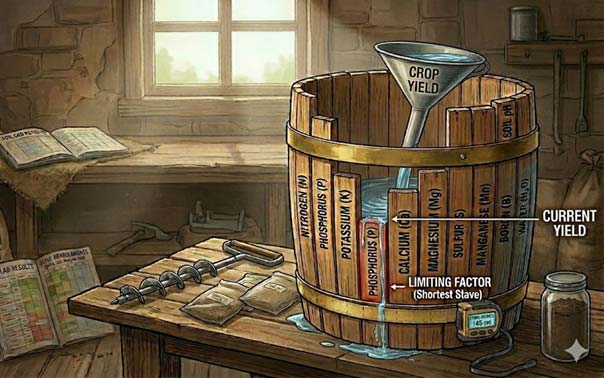
- Primary nutrients: Nitrogen (N), Phosphorus (P), Potassium (K).
- Secondary micronutrients: Sulphur (S), Silicon (Si), Zinc (Zn).
- Environmental factors: Soil pH, drainage, water and soil health.
The capacity of the barrel, your potential yield, is strictly limited by the shortest stave. Even if you “lengthen” the N stave by spending more on urea, the barrel will not hold more water if the P or K stave is still short. In fact, adding more of a nutrient that is already sufficient is like trying to fill a broken barrel; you are paying for expensive inputs that simply leak out of the system. Soil testing and leaf analysis are essentially some of the tools used to measure the height of different staves for your barrel. Such tests will help to ensure that you spend your budget on the specific nutrients that will actually raise your yield capacity.
Addressing constraints
Nutrient use efficiency cannot be achieved while physical and chemical constraints limit crop productivity. Soil constraints such as acidity, compaction, waterlogging, salinity and sodicity act as the most restrictive staves. These conditions must be managed first, as they fundamentally undermine fertiliser efficiency. For instance, high aluminium levels impede root development, causing roots to become stubby and dysfunctional. Simultaneously, low pH limits the availability of nutrients such as P, calcium, magnesium, and molybdenum. Furthermore, a compacted soil layer acts as a physical barrier; if roots cannot penetrate the soil to find water and nutrients, your yield potential is capped regardless of how much you spend on your fertiliser programme.
Explore alternatives
As the price of inorganic fertilisers remain high, exploring alternative nutrient sources is no longer just an environmental choice, it is an economic necessity. Many “waste” products and management practices can provide significant nutrient loadings at a fraction of the cost of bagged fertiliser. These options include organic amendments like chicken litter, kraal manure, and compost, which provide a balanced nutrient profile and improve soil structure. Milling by-products such as filtercake and CMS serve as excellent sources of phosphorus and potassium. On-farm management practices, such as using legumes during the fallow period to fix nitrogen and retaining trash blankets to recycle nutrients, further reduce the need for external inputs.
The typical nutrient concentrations for these amendments are summarised in the table below.
| Product | Total N (%) | P (%) | K (%) | Ca (%) | Mg (%) |
| Chicken litter | 3.00 | 0.62 | 2.08 | 1.52 | 3.12 |
| Spent mushroom compost | 1.00 | 0.26 | 1.28 | 3.11 | 1.55 |
| Filter cake | 0.32 | 0.24 | 0.11 | 0.50 | 1.55 |
| CMS | 0.85 | 0.11 | 8.59 | – | – |
Beyond nutrient replacement, these organic sources drive the buildup of soil organic matter, which improves soil structure and water-holding capacity. This carbon-rich environment fuels soil biology, stimulating the microbial activity essential for nutrient cycling, turning locked-up minerals into plant available food.
OptiFert®: Smart Sourcing for Maximum Cost-Efficiency
A tool like OptiFert® is essential for optimising the economics of your fertiliser programme. Rather than applying a standard ‘one size fits all’ blend, OptiFert® allows for the evaluation of different fertiliser combinations to find the least expensive way to meet the crop’s specific requirements. While calculating fertiliser types and rates is typically straightforward, the process becomes complex when comparing multiple products and fluctuating prices across various fields with different nutrient needs. OptiFert® simplifies this process, providing answers within a few clicks to ensure that your investment is always directed towards the lowest cost unit of nutrient.
To use OptiFert®, simply navigate to www.sasrioptifert.co.za, and input your FAS N-P-K recommendations. The online app will prompt you to input the fertiliser options that you are considering and show you the fertiliser and rate which will supply your fields’ needs most cost-effectively.