

Sharon McFarlane (Senior Plant Pathologist) and Carla Kistan (Assistant Research Officer: Pathology)
Fresh infections of orange rust can be expected from January. Consider protecting your young, susceptible varieties by applying a fungicide during this important period of active cane growth.
Orange rust was first observed on the North Coast in February 2022. Since then, it has spread throughout the industry.
Expected periods of infection
Unlike brown and tawny rust, the seasonal onset of orange rust tends to be in January or February, and symptoms of all three rusts may coincide from April onwards.

Favourable conditions
While all three rusts require a leaf wetness period of at least 8 hours to infect, the temperature requirements for spore germination differ slightly, contributing to the seasonal variation observed.

An orange rust risk model based on spore load and disease severity linked to hourly climate data is being developed as an early warning system to guide fungicide applications, and to identify regions of highest risk.
Yield Loss
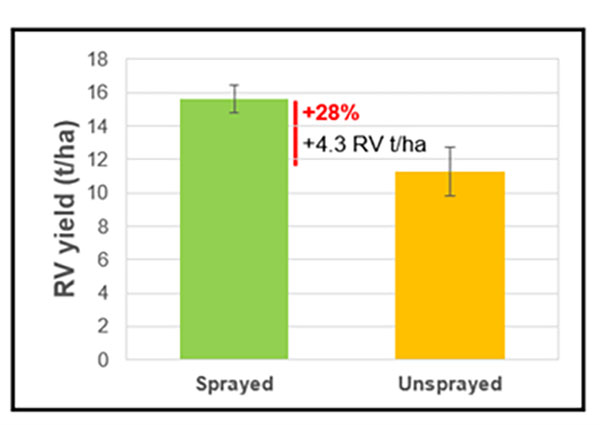 In the latest yield loss trial at Mount Edgecombe, cane and RV yields (t/ha) were 26 and 28% lower in unsprayed plots respectively. This corresponds to the yield loss range of 15-40% reported from other countries.
Orange rust reduces photosynthesis and uses up nutrients while invading the plant. The disease damages the epidermis of the leaf, affecting the ability of the plant to regulate water loss, causing severely infected leaves to die prematurely.
Fungicides
Amistar® Xtra (a.i. azoxystrobin: cyproconazole) is registered against orange rust on sugarcane in South Africa, and this fungicide is still available for use in the industry. The addition of a wetter improves efficacy. Other formulations and alternative products are currently being assessed.
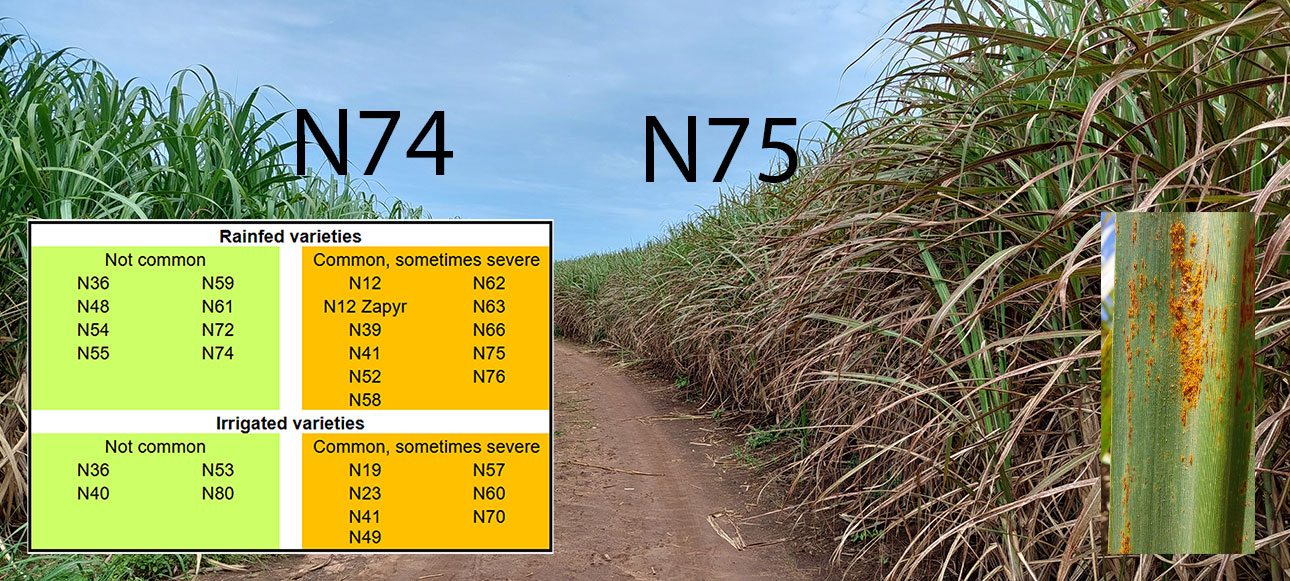
Consider applying a fungicide from January, when the risk of orange rust infection increases, since this is the period of some of the most active cane growth. Look for signs of early infection (see picture below) and prioritise your most susceptible varieties (see table below as a guide, refer to the SASRI website for an updated list of rust ratings). This is particularly important when the cane is young.
An early symptom of orange rust.
Two fungicide applications, approximately 28 days apart, are recommended for effective protection. As the cane matures and the canopy becomes more dense, penetration may be reduced, affecting leaf coverage and uptake, and impacting the efficacy of the fungicide.