

Dr Iona H. Basdew (Biosecurity Scientist)
The incidence of sugarcane has been on the rise this season, with infestations reported across both rainfed and irrigated regions. Young cane (1–4 months old) is most vulnerable, though infestations have occurred in cane up to 9–10 months old. Nymphs and adults avoid sunlight, living in the central leaf spindle; adults can fly and be wind-dispersed.
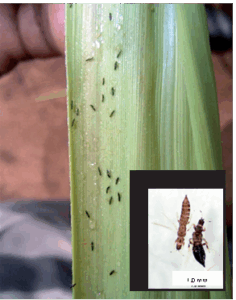
Figure 1. Thrips in the leaf spindle of sugarcane (Inset – magnified view of thrips nymph (left) and adult (right)).
Adults prefer tender leaves, feeding on and laying eggs in the central leaf spindle. Optimal temperatures for egg-laying are 20–25°C. A female can produce up to 80 eggs, which develop into nymphs in five days. Nymphs feed for about 10 days before pupating, and adults live 18–31 days.
Seasonal Occurrence
Thrips follow a seasonal cycle closely linked to temperature (Figure 2). Numbers are low from April to September but rise sharply from November, peaking between December and February. Growers can use this knowledge to protect the crop during its most vulnerable stage.
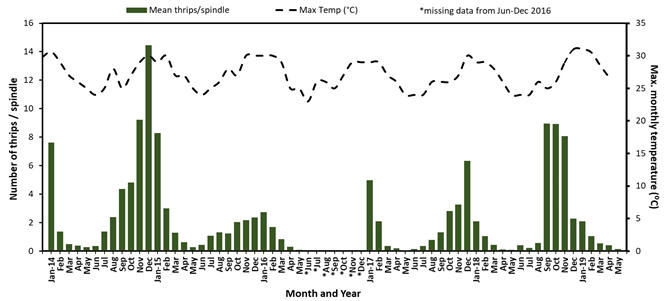
Figure 2. Seasonal cycle of thrips recorded at Umfolozi (2014-2019).
To reduce risk, young crops, especially plant crops of susceptible varieties, can receive in-furrow insecticides. Alternatively, planting in early spring (August–September) or autumn (March–April) avoids having cane under 4 months old during peak thrips activity. Research shows one-month-old sugarcane in mid-summer can reach 60 thrips/leaf spindle, while six-month-old plants may have only 0.3 thrips/spindle. Rainfed and plant cane generally have higher thrips numbers than irrigated or ratoon cane.
Control
Variety choice
Studies have shown that varieties with rapid early growth and unfurling of the central leaf spindle incur less damage, as the microhabitat (refuge) for thrips is reduced. Where possible, select varieties that are less susceptible to sugarcane thrips infestation and damage. An up-to-date list of varieties with their resistance categories can be found on the SASRI eLibrary.
Insecticide use
The following products are currently registered for use against sugarcane thrips:
Table 1: Products registered for use against thrips in South Africa
| Product (and active ingredient) | Dosage rate | Application |
| Bandit® 350 SC (imidacloprid) | 1-2 L product/ha | In the furrow at planting. Note: this product is registered for ground application only. |
| Apache® 350 SC (imidacloprid) |
In furrow at planting:
Foliar spray: |
As soon as the pest is noticed and when at least 3-4 green leaves are present. |
|
Kohinor® 350 SC (imidacloprid) |
1 L product/ha | Registered for application in the furrow at planting. |
| Bandito® GR (imidacloprid + oxamyl) | In furrow at planting: 30 kg/ha Ratoons: 30 kg/ha |
In newly cut and young ratoon sugarcane, apply on the soil surface on both sides of, or over, the plant rows when rainfall is expected or overhead irrigation is available. . |
| Allice® 20 SP (acetamiprid) | 1.5 kg product/ha | Registered foliar spray for ratoon crops, as soon as the pest is noticed and after 6-8 green leaves have developed. May also be applied aerially. |
| Wonderland® 200 SP (acetamiprid) | 1.5 kg product/ha | Registered for foliar application as soon as the pest is noticed on plant and ratoon crops. May also be applied aerially. |
For more detailed information on the use of these products, please read the product labels.
For liquid formulations of imidacloprid, it is extremely important to immediately close the furrow after application to prevent its rapid breakdown by ultraviolet light. Acetamiprid is more UV tolerant and is most effective on a young crop when a targeted spray is applied to the leaf spindle and youngest leaves where sugarcane thrips reside. The granular formulation of Bandito® prevents the breakdown of imidacloprid by UV radiation.
Please contact your SASRI Extension Specialist if you have further queries or require assistance.